
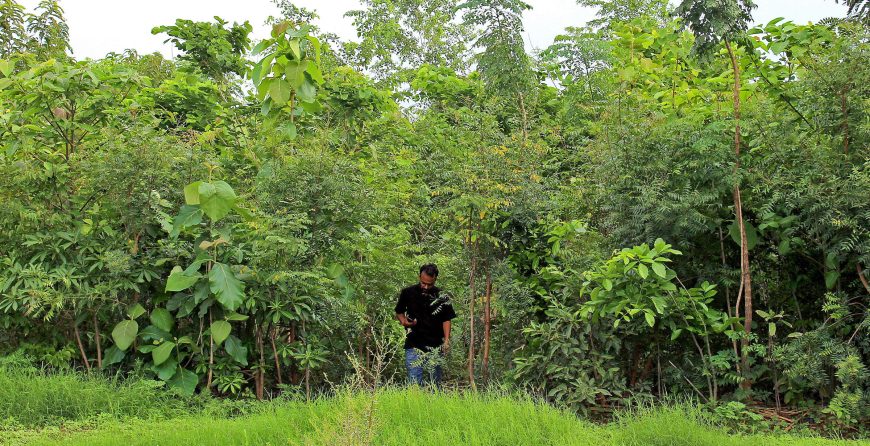
The Pocket-Sized Jungle: A Guide to Miyawaki Forests
Imagine a forest that grows 10 times faster, is 30 times denser, and holds 100 times more biodiversity than a traditional plantation. Now, imagine squeezing that entire ecosystem into your backyard. Welcome to the world of the Miyawaki Forest—the ultimate “hack” for the modern, eco-conscious gardener.
What is a Miyawaki Forest?
Developed by the late Japanese botanist Dr. Akira Miyawaki, this method isn’t just about planting trees; it’s about engineering a “Potential Natural Vegetation” (PNV) system.
In a standard forest, trees compete for light and space over centuries. In a Miyawaki forest, we plant them so closely together that they are forced to shoot upward at lightning speed. By mimicking the layers of a mature native forest—shrubs, sub-trees, trees, and canopy—you create a self-sustaining ecosystem in just two to three years.
Why Every Gardener Should Care
If you have a corner of your yard that feels “dead” or if you want to make a massive environmental impact with minimal space, this is your answer. The benefits:
- Instant Privacy:Within two years, you’ll have a wall of green that no fence can match.
- Micro-Climate Cooling: A Miyawaki forest can lower the surrounding temperature by up to 2°C.
- Noise & Dust Buffer:The density acts as a natural soundproofing barrier.
- The “Lazy” Reward: After the initial three years of care, the forest becomes completely self-sufficient. No pruning, no fertilizing—just pure nature.
The Amateur Gardener’s 4-Step Blueprint: You don’t need a PhD in botany to start your own “micro-jungle.” Here is how to do it:
- The Soil “Super-Charge”
Miyawaki forests thrive because the soil is incredibly loose and nutrient-rich.
- Dig down about 1 meter.
- Mix in organic matter (compost, coco-peat, or rice husks) to improve water retention and aeration. The goal is soil so soft you could push your arm into it.
- The Native Search
Identify native species only. Exotic plants don’t play well in this high-intensity environment. Here is a selection of native Indian trees categorized by the layers needed for a successful Miyawaki forest.
You need a mix of:
- The Sub-Tree / Fruit Layer:Mango , Guava , Indian Gooseberry / Amla, Sita-Ashok
- The Shrub Layer: (The Forest Floor)Curry Leaf , Hibiscus , Henna / Mehndi, Night-flowering Jasmine / Parijat
- The Tree Layer (The Mid-Section)Neem , Indian Rosewood / Sheesham), Bakul , Amaltas
- The Canopy( The Giants)Banyan , Peepal , Arjun , Mahua
A Sample “Mix” for an Indian Backyard
If you are planting a small 10 sq meter patch (approx. 40–50 saplings), a balanced mix would look like this:
- 10% Canopy: (e.g. 5 Peepal or Arjun)
- 30% Tree Layer: (e.g. 15 Neem or Sheesham)
- 30% Sub-Tree: (e.g. 15 Amla or Mango)
- 30% Shrub: (e.g. 15 Curry Leaf or Parijat)

Regional Tip
- For North India (Delhi/Punjab):Include Kikar or Shisham for heat tolerance.
- For South/Coastal India:Include Jackfruit or Coconut (though Coconut is technically a palm, it works well at the edges).
- For Central India:Include Palash (Flame of the Forest).
- The “Crowded” Planting
This feels counter-intuitive to most gardeners: plant 3 to 5 saplings per square meter. Randomize the species so no two trees of the same kind are next to each other. This “chaos” prevents pests from hopping easily from plant to plant.
- The Mulch Blanket
Cover the ground with a thick layer (6 inches) of straw or wood chips. This mimics the forest floor, keeping the roots cool and the soil moist.
Maintenance: The “3-Year Rule”
The Miyawaki method is front-loaded. You work hard early so you don’t have to work later.
- Watering:For the first two years, the forest needs regular watering. The density creates high competition, so don’t let the soil go bone-dry.
- Weeding:Pull weeds for the first 24 months. Once the canopy closes and blocks the sunlight from reaching the floor, weeds will stop growing naturally.
- Support:Use bamboo sticks to support young saplings if you live in a windy area.
- Hands Off: Do not prune. Let the trees fight for light; that struggle is what creates the fast growth and the “jungle” aesthetic.
Fun Fact: A Miyawaki forest becomes 100% self-sustaining after year three. At that point, the only “maintenance” required is walking through it with a cup of coffee to enjoy the birdsong.
Miyawaki Forest in a Tray: While a miyawaki forest in a tray will not be the real thing, but if you want to replicate the aesthetic and the layering of a Miyawaki forest on a miniature scale, follow these steps:
- The Container:Use a deep wooden or ceramic crate (at least 8–10 inches deep). A shallow seed tray won’t work; the trees will die within a month.
- The “Nano” Species: Instead of giant Banyan or Neem trees, use “dwarf” versions or species that naturally tolerate root restriction:
- The Tech Mix: Since there isn’t much soil, it has to be high-performance. Use a mix of:
- 40% Akadama or Pumice (for aeration)
- 40% Compost/Coco-peat (for moisture)
- 20% River Sand (for drainage)
- High-Density Planting: Plant your “mini-trees” much closer than you would in a standard pot—about 2 inches apart. This mimics the dense look of a Miyawaki forest.