
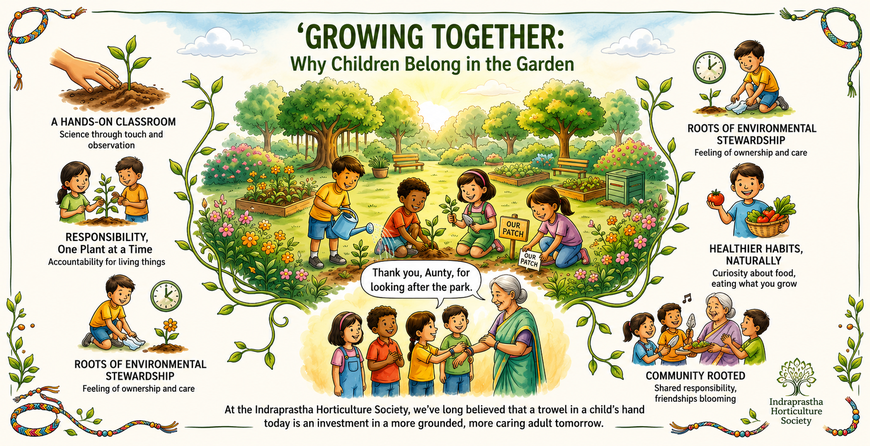
This Friendship Day, I wasn’t expecting any bands. But the doorbell rang, and when I opened the door, four children from the colony stood there, hands behind their backs, clearly hiding something. They asked me to hold out my hand, and one by one, each child tied a friendship bracelet onto my wrist. Then they said, “Thank you, Aunty, for looking after the park.”
They meant the small neighbourhood park near my house, one I’ve informally adopted and tended for the past few years. Over time, the children began coming by, and eventually asked if they could have their own little patch to garden. Now, whenever there’s litter or they find something amiss, they’re the first to report it to me. What started as a few plants growing side by side has become something else entirely — a bond, built through soil and small responsibilities.
It was only after Friendship Day that I fully understood what had happened: these children hadn’t just learned to garden. They had learned to care. And that, in essence, is the strongest argument for involving children in gardening from an early age.
A Hands-On Classroom
Gardening offers children something increasingly rare in their daily lives: direct, unmediated contact with the natural world. Long before they can grasp abstract lessons about ecosystems or sustainability, children can watch a seed swell, split, and send up its first green shoot. They can feel soil crumble between their fingers, notice which plants wilt without water, and see for themselves how sunlight changes a leaf’s colour. This is science taught not through textbooks but through touch, patience, and observation — and lessons learned this way tend to stay.
Responsibility, One Plant at a Time
A garden is an excellent teacher of responsibility, precisely because it doesn’t forgive neglect. A child who forgets to water a seedling for a week will see the consequences plainly, and a child who tends it faithfully will be rewarded with a flower or a vegetable they can call their own. This cause-and-effect relationship, repeated daily over a season, builds a sense of accountability that few other activities offer so gently or so clearly. The children who now watch over their patch in our park don’t need reminding to care for it. They’ve simply absorbed that this is theirs to look after.
Patience in an Impatient Age
We live in a world engineered for instant results, where children swipe, click, and expect immediate gratification. Gardening runs on an entirely different clock. A seed doesn’t sprout overnight, and a fruit doesn’t ripen because a child wishes it would. In learning to wait — to check on a plant day after day without rushing it — children quietly develop patience and delayed gratification, qualities that serve them well far beyond the garden bed.
Roots of Environmental Stewardship
Children who grow up digging in soil, planting saplings, and watching pollinators visit flowers rarely need to be lectured about protecting the environment. They already understand, in a felt and personal way, that ecosystems are delicate and worth protecting. This is precisely why the children in my neighbourhood took it upon themselves to report litter in the park. They weren’t asked to police the space; they simply felt it was theirs, and that feeling of ownership is the beginning of genuine environmental stewardship — one far more durable than anything taught through slogans alone.
Healthier Habits, Naturally
There’s also a simple, practical benefit: children who grow vegetables are far more likely to eat them. A child who has nurtured a tomato plant from seedling to fruit takes genuine pride in eating what they’ve grown, and that pride often extends to a broader curiosity about food and where it comes from. Gardening, in this sense, becomes an easy and enjoyable route toward healthier eating habits, achieved without a single lecture on nutrition.
Community Rooted
Perhaps the least discussed but most valuable outcome is what gardening does for community bonds. Gardens are rarely solitary spaces; they invite neighbours, friends, and, as I discovered, entire groups of children to gather, share tools, and celebrate small victories, like a flower’s first bloom, together. Our little park patch grew into something more than a gardening project. It became a meeting point, a shared responsibility, and eventually, an occasion for a group of children to want to thank someone with a bracelet made by hand.
Planting Early, Harvesting for Life
The case for introducing children to gardening early isn’t only about future environmentalists or healthier eaters, though it produces both. It is about giving children an early, embodied understanding of patience, responsibility, and care — qualities that, once rooted, tend to grow for a lifetime. A child who has tended a garden learns that small, consistent effort yields real results, and that caring for something outside themselves is deeply rewarding.
At the Indraprastha Horticulture Society, we’ve long believed that a trowel in a child’s hand today is an investment in a more grounded, more caring adult tomorrow. Sometimes, the proof arrives in the smallest of ways: a doorbell ringing, a small hand extended, and a friendship bracelet tied by children who once simply wanted a patch of earth to call their own.